Stop Fighting Streams: Native Multipart Uploads in ODAC.JS

If you have ever built a production-grade file upload system in Node.js, you know the pain. You typically find yourself wrestling with third-party middlewares like Multer, manually piping streams with Busboy, or trying to figure out why a temporary file was never cleaned up. It is a boilerplate-heavy process that feels disconnected from the rest of your framework.
With the latest update to ODAC.JS, that friction is officially gone. We have integrated high-performance multipart parsing directly into the core engine. No more extra dependencies. No more manual middleware configuration. Just pure, native file handling that works exactly the way you expect.
The Zero-Config Philosophy
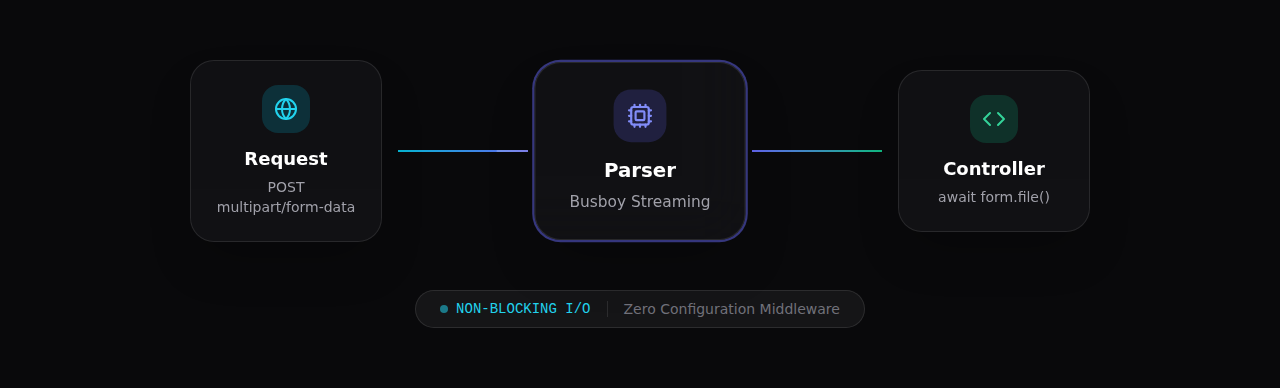
In ODAC.JS, we believe the framework should handle the heavy lifting of the HTTP protocol so you can focus on your business logic. When you add a file input to an <odac:form>, the framework intelligently detects it. It automatically sets the correct enctype and prepares the server-side stream parser before your controller even breathes.
This is not just about convenience: it is about performance. By using busboy under the hood, we ensure that files are parsed with minimal memory overhead, even when dealing with massive multi-gigabyte uploads.
Show Me The Code
Here is how simple it is to build a profile picture upload feature. No app.use(), no configuration objects, just clean markup and a straightforward controller method.
The View
The <odac:form> tag now scans its children. If it finds a file input, it handles the multipart encoding for you.
<odac:form action="Profile.upload">
  <odac:input name="avatar" type="file" label="Profile Picture">
    <odac:validate
      rule="required|maxsize:2MB|ext:jpg,png"
      message="Please upload a JPG or PNG image under 2MB"
    />
  </odac:input>
  <odac:submit text="Upload Image" loading="Processing..."/>
</odac:form>
The Controller
On the server, your controller receives a form object that makes file access as simple as a single method call.
// controller/Profile.js
async upload(form) {
  // Access the validated file object
  const avatar = await form.file('avatar')

  // Move it to permanent storage with a safe, server-side path
  await avatar.move(`./storage/uploads/${avatar.name}`)

  return form.success('Profile picture updated successfully!')
}
Guarding Your Gates: Built-in Validation
Security is a first-class citizen in ODAC.JS. Allowing users to upload files is one of the most common attack vectors in web applications, which is why we built a robust validation layer specifically for multipart data.
You can now enforce strict constraints directly in your template or via the ODAC.VALIDATOR service. ODAC.JS goes beyond just checking extensions: it performs automatic content sniffing for common image formats (JPEG, PNG, GIF, WebP) to prevent attackers from disguising malicious scripts as harmless images.
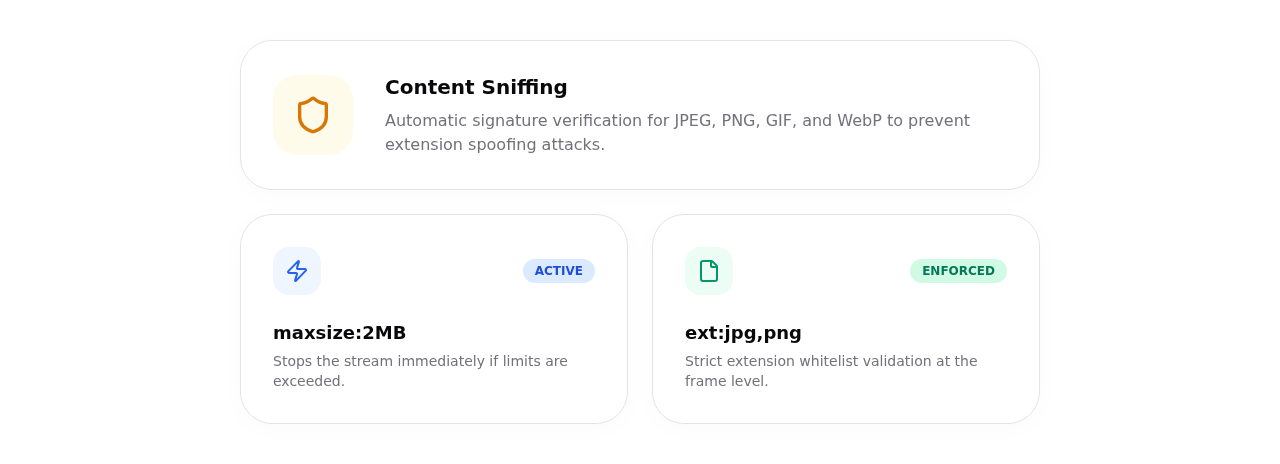
- maxsize: Prevent server exhaustion by limiting file sizes (e.g.,
2MB,500KB). - mimetype: Restrict uploads to specific media types or use wildcards like
image/*. - ext: Ensure files have the correct extensions.
- maxfiles: Control the number of files in a
multipleupload scenario.
Under the Hood: The Multipart Lifecycle
When a request hits your ODAC.JS application, the ODAC.REQUEST layer identifies the multipart/form-data content type. It initializes a non-blocking stream parser that processes the incoming data in chunks.
If you have defined validation rules, the framework checks them on the fly. If a file exceeds the maxsize limit, the stream is halted immediately, saving your server from processing unnecessary data.
Temporary files are managed automatically. If your controller completes without moving a file to a permanent location, ODAC.JS cleans up the temporary storage, ensuring your disk space remains pristine.
Conclusion
Handling file uploads should not be a weekend project. By bringing multipart support into the ODAC.JS core, we have eliminated a massive source of boilerplate and potential security holes. Whether you are building a simple blog or a complex document management system, ODAC.JS provides the enterprise-grade tools you need to handle files with confidence and speed.
Stop fighting with streams and start building. The future of Node.js file handling is native, and it is here in ODAC.JS.