How Moving from Node.js to Go Cut Our Agent Footprint to Near-Zero

Hosting your own applications shouldn't mean sacrificing half your server's memory to the very agent that manages them. Yet, that is exactly the tax many modern self-hosted platforms levy on your hardware. For a long time, the server-side agent of ODAC depended on a Node.js runtime environment, carrying along package installation overhead and noticeable background memory usage.
To build an enterprise-grade platform, we knew we had to break free from this model. Today, we are thrilled to announce that ODAC v2.0.0 is officially live, featuring a complete architectural rewrite of both our core server and CLI command tool in Go. By compiling our orchestration loops and system management daemons directly into statically linked Go binaries, we have eliminated the Node.js requirement completely, reduced baseline execution overhead to near-zero, and established a rock-solid foundation for high-density multi-tenant hosting.
The Architectural Bottleneck of the Old Agent
In previous iterations, running the ODAC agent meant installing Node.js, managing npm dependencies, and dealing with distribution-specific package issues on host machines. Every time the control plane executed a system task, spawned an application container, or performed port validation, it was subject to the startup latency of a JavaScript runtime. For lightweight server instances or high-density deployments, these megabytes of overhead quickly compounded.
Inter-process communication also suffered from single-threaded limitations. While Node's asynchronous event loop is great for high-throughput web traffic, it introduces lock contention and scheduling delays when coordinating complex container builds, real-time logging, and system-level networks simultaneously.
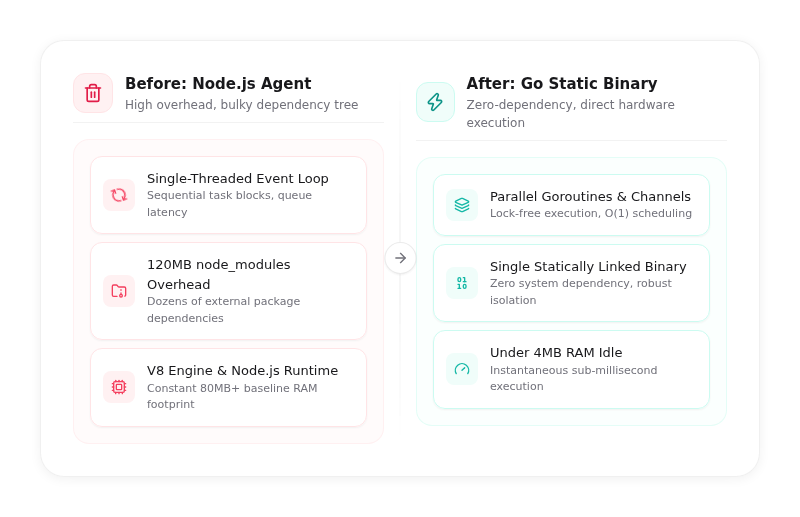
We realized that to scale ODAC to millions of operations with zero baseline noise, the agent needed to exist as a native, zero-dependency background daemon. It had to execute instantly, consume minimal idle memory, and interact directly with system APIs. Go was the clear and uncompromising answer.
Rewriting the Core: From Single-Threaded Loops to Goroutines
The migration to Go completely redefines how the self-hosted ODAC agent interacts with host systems. Key subsystems like container supervision, log collection, system info metrics, port validation, and update management have been fully rewritten as Go packages under the internal/ namespace.
By utilizing Go's native channels and concurrency primitives, the new agent executes deployments in parallel without blocking. Goroutines allow ODAC to supervise container lifecycles, stream build logs, and monitor system-level resource utilization concurrently. All of this runs inside a single compiled daemon that runs smoothly as a systemd service.
// From internal/appmgr/ops.go: native Go concurrency handling
go func() {
    log.Log("Initiating parallel container deployment loop")
    // Native Go channels coordinate container state transitions smoothly
}()
Instead of spawning external shell wrappers, our server leverages the official Go Docker SDK directly to drive Docker API operations. This native integration reduces context switching overhead and provides structured, type-safe control over your application containers.
Before vs. After: The Performance Impact in Numbers
This architectural overhaul has dramatically optimized the footprint of our background agent. Let us look at the dramatic before-and-after contrast:
- Before the Migration: The ODAC agent required a full Node.js runtime and dependency chain to execute server-side commands, consuming substantial background memory and introducing package management complexities across diverse Linux distributions.
- After the Migration: The entire server and CLI are compiled into single, statically linked Go binaries. This provides instantaneous command execution, minimal idle resource usage, and a completely self-contained installation.
Under the new architecture, the background daemon operates on an idle footprint of just a few megabytes. Startup latency is completely gone, and CLI operations execute in milliseconds rather than tenths of a second.
Driving Operations from the Cloud or Terminal
This migration preserves our focus on developer ergonomics. Creating and managing application containers has never been faster. You can trigger application builds, manage domains, and view logs directly from the cloud or your favorite terminal.
Because all core server capabilities are exposed via WebSocket commands, you can manage your applications with a single click from the cloud dashboard at app.odac.run. If you prefer operating via the terminal, the new compiled odac CLI command tool makes it incredibly simple.
For instance, to spin up a new application container, you can launch it instantly from the cloud interface or run this simple terminal command:
odac app create -n my-web-app -u https://github.com/example/my-repo.git
Similarly, assigning a custom domain and ensuring instant routing is just as streamlined. You can configure your routing tables with one click in the dashboard, or run the following terminal command to map your domain to your application:
odac domain add my-app.com my-web-app
Once the domain is registered, renewing the SSL certificate is automated. If you ever need to trigger an immediate renewal manually, you can do it via the dashboard or directly with the CLI:
odac ssl renew my-app.com
Every command is processed instantaneously, with the odac CLI interacting with the local odac-server daemon over an optimized TCP API socket binding.
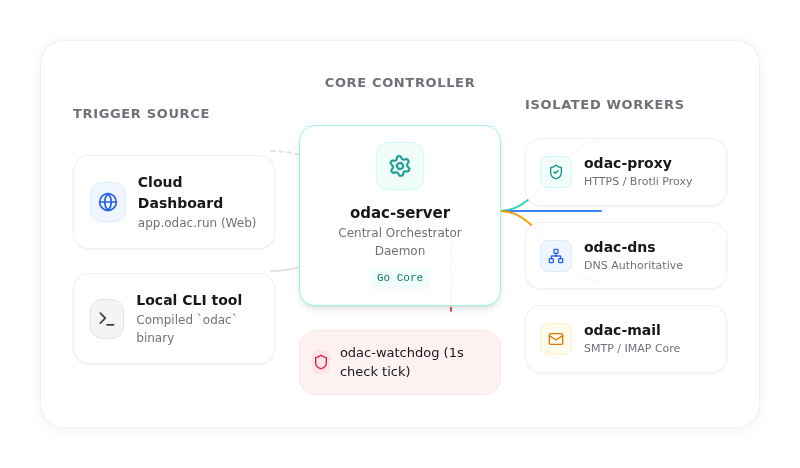
A Hardened, Independent Process Architecture
The rewritten ODAC agent is architected around robust failure isolation. Rather than running a monolithic process where a single failure can bring down the entire system, ODAC v2.0.0 isolates operations across distinct data-plane binaries.
The main odac-server orchestrator delegates specialized networking and communication tasks to independent background daemons, specifically odac-proxy, odac-dns, and odac-mail. Each daemon runs as its own operating system process, representing an independent crash domain. If a mail-parsing edge case causes an unexpected crash in odac-mail, your main web proxy, DNS server, and orchestrator continue running without interruption.
Our system watchdog immediately monitors and revives any dead sub-processes on a one-second tick, guaranteeing maximum system uptime and uninterrupted service.
Modernizing the Development and Contributor Workflow
For contributors and system operators, this rewrite dramatically simplifies development. The old Node.js testing harness, npm scripts, and complex setup procedures are gone.
The entire codebase is now verified natively using Go's built-in tooling. To run the full unit and integration test suites, developers can run a single native command:
go test ./...
Toolchain gates are also strictly enforced. Every commit must pass gofmt and go vet validation, ensuring that our codebase remains pristine, readable, and highly maintainable for the open-source community.
We are incredibly excited about this milestone. The transition to Go represents more than just a speed upgrade: it is a fundamental shift that enables us to deliver a fast, reliable, and truly independent cloud platform for developers worldwide.