No More Silent Failures: ODAC.JS v1.4.12 Masterminds SMTP Deliverability
You have built the perfect notification system.
Your templates are beautiful, your logic is sound, and your tests pass.
But then, the reports start trickling in: "I did not get the email."
You check your application logs and see success.
You check your mail relay and find a cold, hard rejection.
The culprit is often a single line of HTML that was just a few characters too long for a protocol older than the web itself.
The Archaic Rule of 1000 Characters
The SMTP protocol, defined by RFC 5321, is the backbone of email communication.
It contains a strict, often forgotten rule: lines of text must not exceed 1000 characters, including the carriage return and line feed.
When you send a modern, complex HTML email, a single <table> row or a minified CSS block can easily shatter this limit.
Strict mail servers, like those powering Office 365 or Gmail, may silently drop these emails or reject them with cryptic errors.
Most developers assume their mail library or relay handles this, but that is a dangerous gamble.
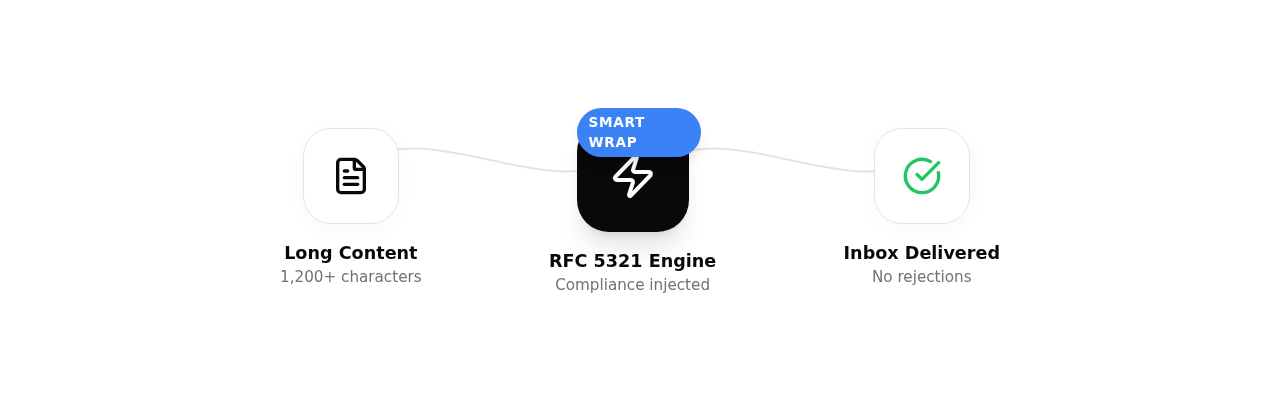
Enter ODAC.JS v1.4.12: Intelligent Line Wrapping
In ODAC.JS v1.4.12, we decided that "it usually works" was not good enough for an enterprise-grade framework.
We have fortified the Mail service with a sophisticated, automatic line-wrapping engine.
This engine identifies lines that approach the danger zone and intelligently injects compliant line breaks.
It uses CRLF as the break character to strictly follow the RFC requirements, ensuring your mail is accepted by even the most pedantic relays.
Precision Engineering for HTML and Text
Not all content should be wrapped the same way.
Our implementation distinguishes between HTML and plain text to preserve both deliverability and readability.
- HTML Content: Wrapped at a safe 990-character limit. The engine looks for logical break points to avoid breaking tags mid-word.
- Plain Text Content: Wrapped at 76 characters, the golden standard for terminal readability and old-school mail clients.
This happens entirely under the hood.
You do not need to configure anything or change a single line of your existing code.
Freedom from Templates
While templates are the standard for large applications, sometimes you just need to send a quick notification.
ODAC.JS v1.4.12 officially supports sending raw HTML or plain text directly from the service.
// A quick, secure notification with automatic wrapping
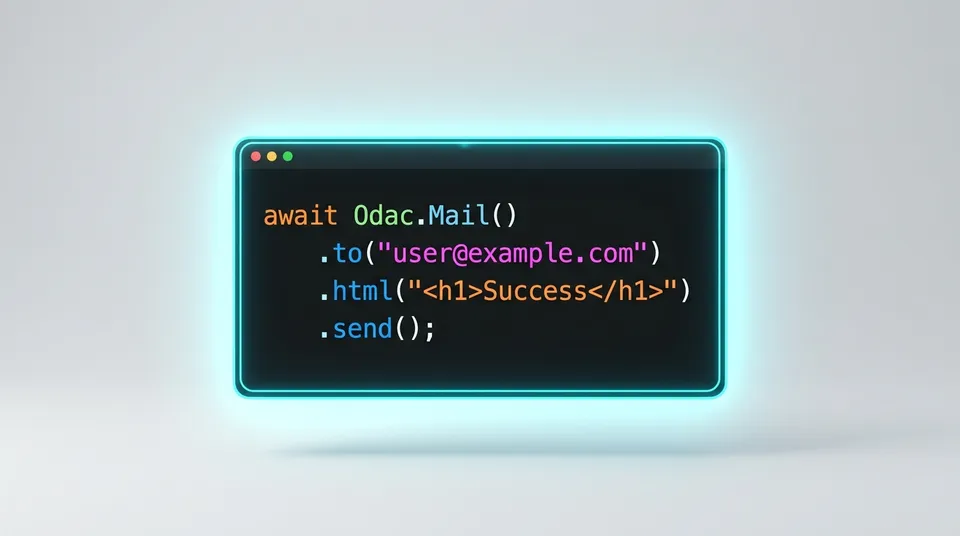
await Odac.Mail()
  .to('security@enterprise.com')
  .subject('Unauthorized Access Attempt')
  .html('<h1>Security Alert</h1><p>A login attempt was blocked from an unknown IP address.</p>')
  .send();
The line wrapper treats this raw content with the same rigor as it does for views stored in the filesystem.
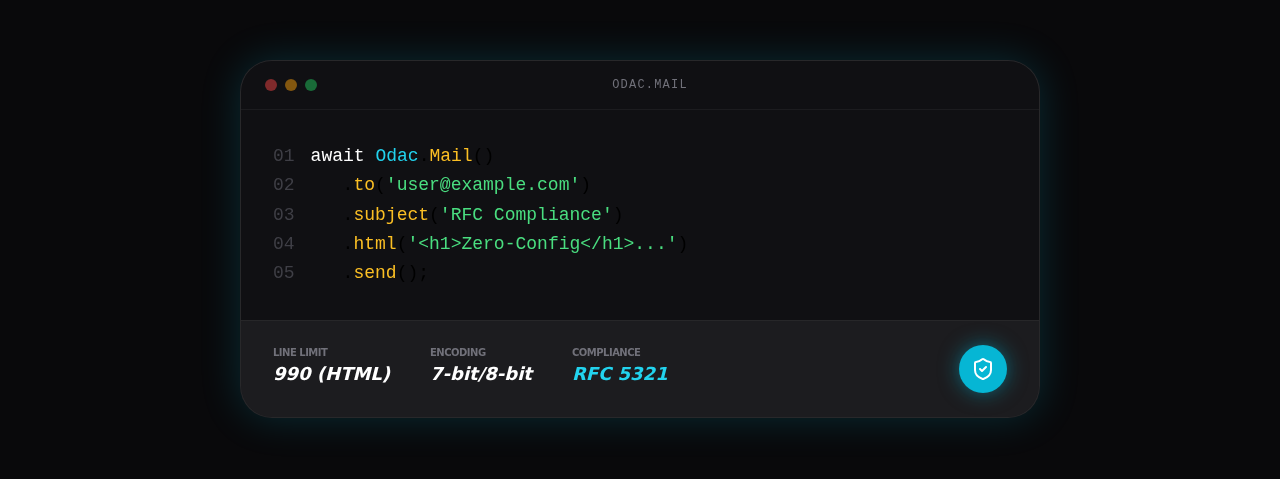
Why We Refused to Compromise
We could have left this to the user, but that violates the ODAC.JS philosophy of "Maximum Power, Zero Config."
Enterprise software should be resilient by default.
By building RFC compliance directly into the core, we eliminate a whole class of "heisenbugs" that haunt production mail systems.
Your job is to write the message: our job is to make sure it arrives.
Show Me The Code: The Fluent Mail API
The Odac.Mail service continues to provide the most intuitive, chainable API in the Node.js ecosystem.
Whether you are using a template or raw strings, the experience remains consistent.
// Using a template from view/mail/welcome.html
await Odac.Mail('welcome')
  .from('no-reply@myapp.com', 'My App Team')
  .to('newuser@example.com')
  .subject('Welcome to the Future')
  .send({
    user_name: 'Jules',
    confirmation_link: 'https://myapp.com/verify'
  });
With v1.4.12, every email sent through this API is now fortified against the quirks of the global SMTP network.
It is just another way ODAC.JS is building the most reliable foundation for your next big idea.