Why Your Apps Feel Faster on ODAC

Performance tuning is usually a dark art. You spend hours tweaking buffer sizes, cache TTLs, and eviction policies, only to realize that what worked for your staging environment is absolute garbage for your production traffic. Most cloud platforms expect you to be a sysadmin, a network engineer, and a performance specialist all at once.
We think that is a waste of your time.
At ODAC, we believe infrastructure should be smart enough to tune itself. We have just rolled out a suite of adaptive performance upgrades to the ODAC Cloud that make your applications faster and more resilient by default. No config files, no complex YAML, and definitely no "tuning" required.
The Cache That Thinks for Itself
Standard caching is binary: it is either on or off. If you are lucky, you get to set a fixed size. If you are unlucky, you run out of memory and your server crashes.
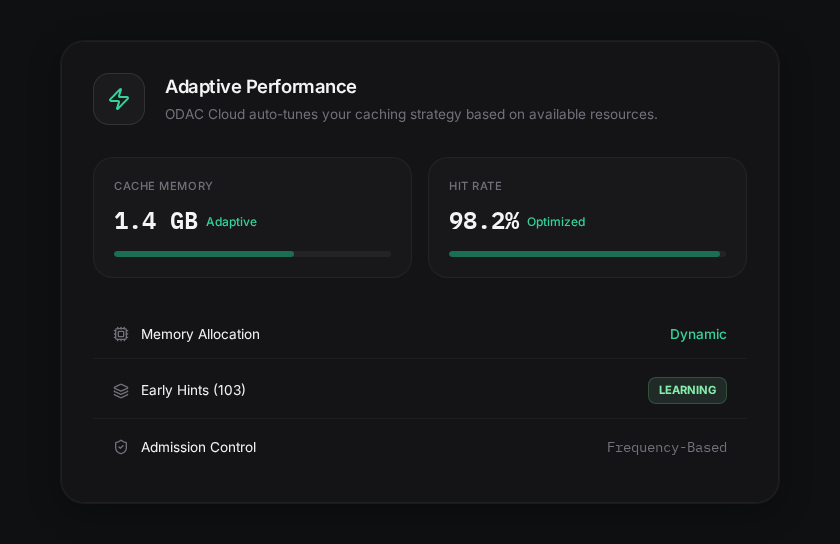
The new Adaptive Performance Suite in ODAC introduces a memory-aware cache engine. Instead of a rigid allocation, ODAC monitors your server's available RAM in real-time. If you are running on a high-memory beast, ODAC expands the cache to keep more of your data ready. If you are on a lean VPS, it scales back gracefully to ensure your application always has the breathing room it needs.
But it is not just about size: it is about intelligence. Using frequency-based admission control, ODAC learns which assets are "hot" and which are "noise". Only the most requested data earns a spot in the cache, ensuring that your limited memory is never wasted on one-off requests.
Prefetching the Future with 103 Early Hints
The biggest bottleneck in web performance is often the "Think Time", that awkward gap where the browser is waiting for your backend to generate HTML. While your server is busy querying databases, the browser is sitting idle, doing nothing.
ODAC now automatically learns your application's requirements. By observing your responses, ODAC identifies critical CSS and JavaScript files that your users always need. On subsequent visits, the ODAC proxy serves HTTP 103 Early Hints immediately.
This allows the browser to start prefetching assets while your backend is still processing the main request. By the time your HTML reaches the user, the styling and logic are already there. The result? A dramatic reduction in Largest Contentful Paint (LCP) and a site that feels instant.
Granular Control via Headers
Sometimes, you want to tell the proxy exactly what to do. We have made this as simple as sending a single header. You can now opt-in to HTML page caching by sending the X-Odac-Cache header from your application.
// In your Node.js or Express app
res.set('X-Odac-Cache', '600'); // Cache this page for 10 minutes
res.send('<h1>My Fast Page</h1>');
To keep things secure and consistent, ODAC uses advanced body hashing to verify content stability before serving it from the cache. If your content changes, the cache invalidates automatically. You get the speed of a global CDN with the precision of a local variable.
Zero-Downtime is No Longer Optional
Deploying an update should never feel like a gamble. Traditionally, platforms use fixed delays to wait for a new version to "stabilize" before killing the old one. If the new version fails to start, your site goes down.
We have replaced those "fingers-crossed" delays with Readiness-Aware Handover. The ODAC deployment pipeline now performs dynamic readiness checks. It verifies that the new instances have fully synchronized their configurations and are healthy before the old container is signaled to shut down.
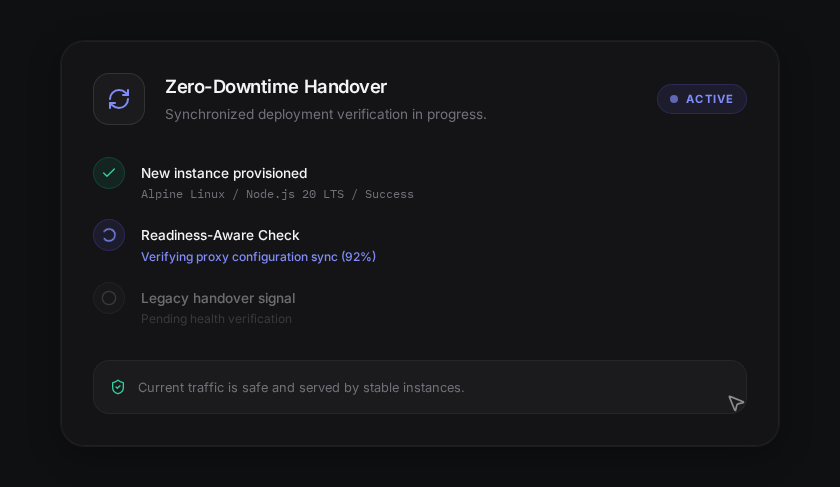
Whether you are updating a simple web app or a complex DNS configuration, the transition is seamless. You focus on writing code: ODAC focuses on keeping it online.
The best part? These features are already active on app.odac.run. Connect your server, deploy your app, and feel the difference.
If you prefer the terminal, you can check your connected domains anytime:
odac domain list
Welcome to a faster, smarter cloud.