ODAC.JS Unleashed: The End of Frontend Tooling Fatigue
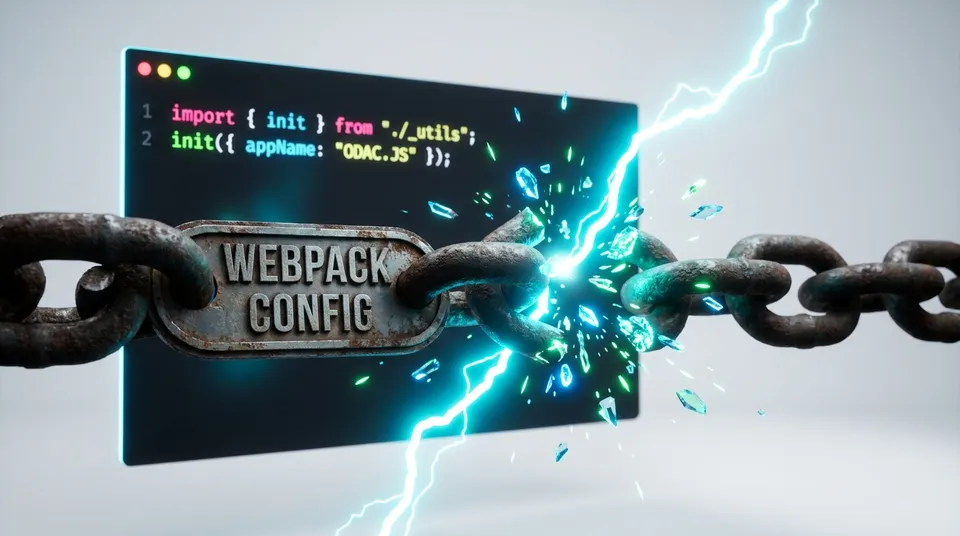
Stop wrestling with webpack.config.js and say goodbye to the fragile house of cards that is your frontend build pipeline. For too long, Node.js developers have been forced to choose between a "batteries-included" backend and a frontend ecosystem that feels like a full-time job to maintain. We decided that "Zero-Config" shouldn't stop at the server boundary.
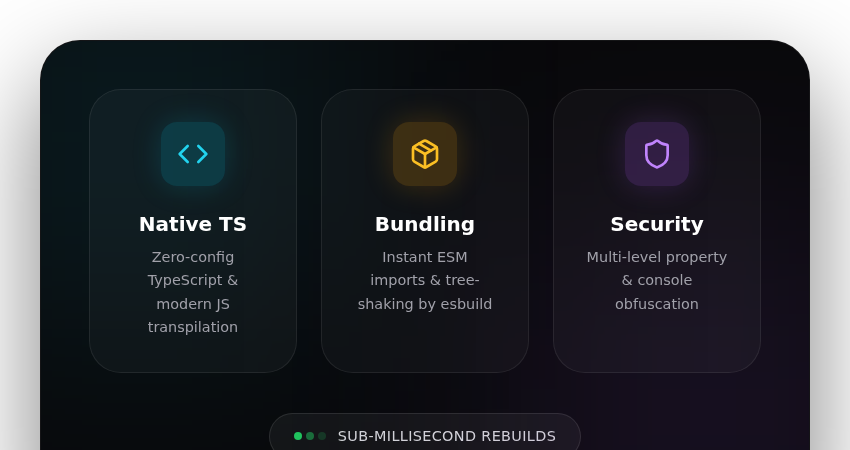
ODAC.JS has officially expanded its core philosophy to the frontend with a native, esbuild-powered scripts pipeline. You can now write modern JavaScript or TypeScript directly in your project and have it bundled, transpiled, and minified without ever touching a configuration file.
The Problem: The "Middleman" Tax
Before this update, ODAC.JS focused heavily on the Tailwind CSS pipeline. It was fast, it was clean, and it worked. But when it came to JavaScript, we left the choice to you. Unfortunately, that choice often meant importing a dozen devDependencies, configuring Babel, and praying that your HMR (Hot Module Replacement) didn't break when you looked at it the wrong way.
We realized that for most enterprise applications, you don't need a custom-built, bespoke bundling strategy. You need speed, reliability, and TypeScript support that just works. By integrating esbuild directly into the ODAC.JS core, we've eliminated the "Middleman Tax" of frontend tooling.
Show Me The Code
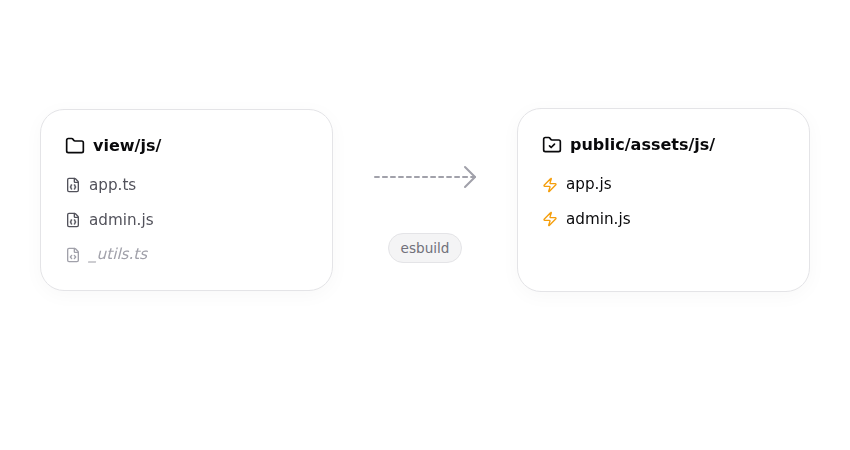
Getting started is as simple as creating a file. If you put a .ts or .js file in view/js/, ODAC.JS considers it an entry point.
// view/js/app.ts
interface Config {
  appName: string
}

const init = (cfg: Config) => {
  console.log(`${cfg.appName} frontend initialized!`)
}

init({ appName: 'ODAC.JS' })
To use it in your application, just reference the compiled asset in your skeleton:
<script src="/assets/js/app.js"></script>
Behind the scenes, ODAC.JS handles the mapping. In development, it serves a source-mapped version with sub-millisecond rebuild times. In production, it gives you a highly optimized, minified bundle.
Architected for Performance
We chose esbuild for one reason: it is obscenely fast. While other bundlers are written in JavaScript, esbuild is written in Go, allowing it to perform parallelized transpilation that leaves traditional tools in the dust.
When you run odac dev, the framework starts a watcher that tracks every file in view/js/. When you hit save, the rebuild is often finished before your hand leaves the keyboard.
Smart Entry Points
Not every file should be a public bundle. ODAC.JS follows a simple convention: files prefixed with an underscore (e.g., _utils.ts) are treated as shared modules. They won't generate their own entry point in public/assets/js/, but they can be imported by any other script.
// view/js/_api.ts
export const getUser = async (id: number) => {
  const res = await fetch(`/api/users/${id}`)
  return res.json()
}

// view/js/profile.ts
import { getUser } from './_api'

getUser(1).then(user => console.log(user))
Production-Grade Security
For enterprise deployments, sometimes minification isn't enough. ODAC.JS introduces built-in obfuscation levels that you can toggle in your odac.json configuration.
- Low: Mangles private-by-convention properties (starting with
_). - Medium: Low + drops
debuggerand specific console calls. - High: Maximum mangling of
_and$prefixed properties, plus a total "console blackout".
{
  "js": {
    "target": "es2022",
    "minify": true,
    "obfuscate": "medium"
  }
}
A word of caution: If you are using external libraries like jQuery that rely heavily on
$-prefixed symbols, the "High" obfuscation level might be too aggressive. Always test your production bundles before shipping.
How to Get Started
If you're already running an ODAC.JS project, you're just one command away from the future of frontend development.
- Organize: Move your scripts to
view/js/. - Develop: Run
npx odac dev. Watch the logs as your assets are built in real-time. - Build: When you're ready for the world, run
npx odac build. Your optimized bundles will appear inpublic/assets/js/.
We've built ODAC.JS to be the framework we always wanted: powerful, opinionated where it matters, and fast enough to keep up with your imagination. With the new frontend pipeline, the last piece of the "Zero-Config" puzzle has finally snapped into place.