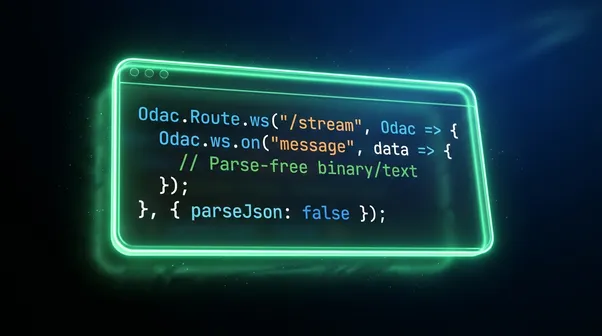
Rock Solid Real-Time WebSocket Reliability in ODAC.JS
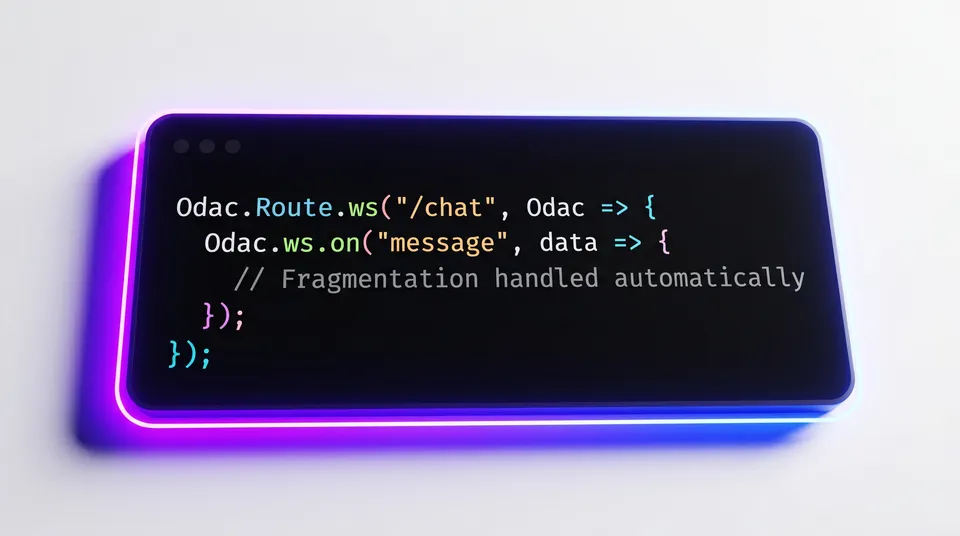
The dirty secret of real-time web development is that WebSockets are often far less reliable than we pretend. Between silent disconnects, partial data frames, and the "ghost connection" problem, building an enterprise-grade real-time system is a minefield of edge cases. Most frameworks leave you to navigate these hazards alone, but ODAC.JS takes a different approach.
We believe that real-time communication should be as robust and predictable as a standard HTTP request. To achieve this, ODAC.JS now features native message fragmentation support and a precision state machine that tracks every connection with surgical accuracy.
The Before and After
Until now, managing WebSockets in Node.js meant dealing with two major DX pain points: data integrity and state management.
Previously, WebSocket connections often relied on simple boolean flags to track closure. If a network blip happened, you were left guessing if the socket was truly dead or just resting. Worse, large messages exceeding the frame limit could result in partial data arriving at your handler, forcing you to write complex reassembly logic yourself.
Now, ODAC.JS handles the heavy lifting. The framework manages the full RFC 6455 state machine and frame reassembly internally, ensuring your application code stays clean and focused on business logic.
The Fragmentation Nightmare
The WebSocket protocol allows messages to be split into multiple frames. While this is great for high-throughput environments, it is a common source of data corruption if handled incorrectly. If your framework does not reassemble these continuation frames, your logic might receive a truncated JSON string or a mangled buffer.
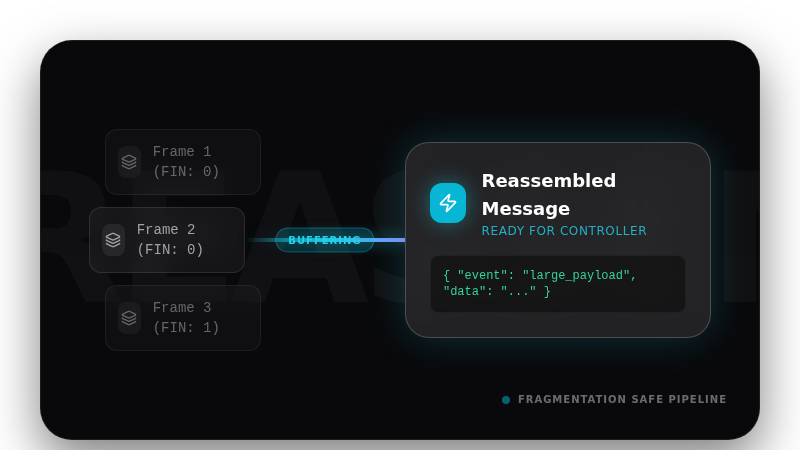
ODAC.JS eliminates this entire category of bugs. Here is how the new reassembly pipeline works:
- Detection: A client sends a large payload fragmented into three frames. ODAC.JS receives the first frame and recognizes it as a fragmented start.
- Buffering: It transparently buffers subsequent continuation frames.
- Delivery: Only when the final frame is received is the complete, validated message delivered to your controller.
Show Me The Code
Here is how you handle high-throughput real-time data in ODAC.JS without breaking a sweat:
// route/websocket.js
Odac.Route.ws('/analytics', Odac => {
  Odac.ws.on('message', data => {
    // Large, fragmented payloads are automatically reassembled here
    const { event, payload } = data;
    processAnalytics(event, payload);
  });
});
Precise State Tracking
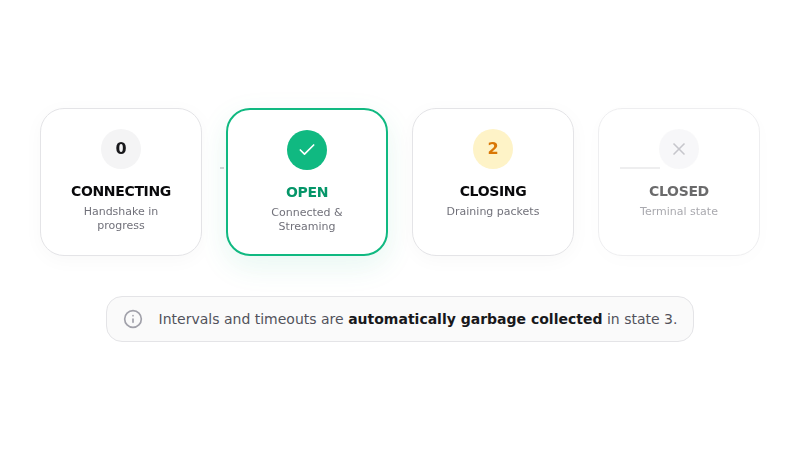
A WebSocket connection is not just "on" or "off." It is a living entity with a specific lifecycle. ODAC.JS provides a reliable state machine based on readyState constants. By exposing these states directly through the Odac singleton, the framework allows you to write defensive code that understands exactly where the connection stands.
| Value | Constant | Description |
|---|---|---|
0 |
CONNECTING |
Handshake complete, handler not yet invoked. |
1 |
OPEN |
Active connection ready for data. |
2 |
CLOSING |
Close frame sent, waiting for socket drain. |
3 |
CLOSED |
Connection fully terminated. |
Writing Defensive Real-Time Logic
Using the READY_STATE enum available on the Odac object, you can ensure that your application never attempts to perform an operation on a dying connection.
Odac.Route.ws('/dashboard', Odac => {
  Odac.setInterval(() => {
    // Only send data if the connection is actually OPEN
    if (Odac.ws.readyState === Odac.READY_STATE.OPEN) {
      Odac.ws.send({
        cpu: process.cpuUsage(),
        memory: process.memoryUsage()
      });
    }
  }, 1000);
});
In ODAC.JS, intervals created with Odac.setInterval() are automatically cleaned up when the connection closes. This prevents the memory leaks that plague traditional Node.js WebSocket implementations.
Scaling Without Compromise
While ODAC.JS makes WebSockets easy to use, it does not sacrifice performance or security. You can still enforce strict maxPayload limits to prevent memory exhaustion, and built-in rate limiting ensures that a single runaway client cannot saturate your server.
Odac.Route.ws('/chat', 'ChatController', {
  maxPayload: 5 * 1024 * 1024, // 5MB limit
  rateLimit: {
    max: 100,
    window: 1000
  }
});
By combining automatic fragmentation reassembly with precise lifecycle management, ODAC.JS delivers the "Enterprise-Grade" stability that modern real-time applications demand. Stop fighting the protocol and start building features.