Stop Drowning Your Database with ODAC.JS
In the world of high-concurrency Node.js, your connection pool is your most precious resource. Every time you track a page view, update a "last active" timestamp, or log a non-critical event, you are burning a ticket to talk to your database. At scale, this isn't just inefficient: it is a recipe for catastrophic failure.
One million page views should not mean one million UPDATE queries. Most frameworks leave you to solve this with a mess of Redis-backed queues or third-party cron jobs. With ODAC.JS, we decided that the framework should handle the heavy lifting of write-aggregation natively.
The Problem: The Death of a Thousand Writes
Traditional Node.js patterns for tracking high-frequency events are remarkably wasteful. If you have 50 workers all trying to increment a counter simultaneously, you are fighting for locks and saturating your I/O just to move a number from 100 to 150.
We saw developers struggling with connection pool exhaustion just because they wanted real-time analytics. The architectural trade-off was always "Slow but Accurate" vs "Fast but Complex". We refused to accept that complexity was the only way forward for enterprise-grade applications.
Enter the Write-Behind Cache
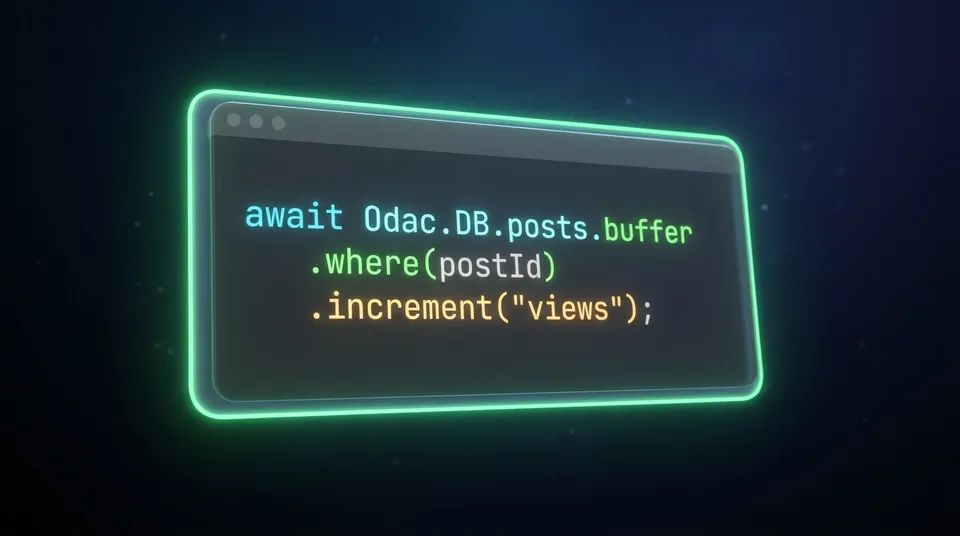
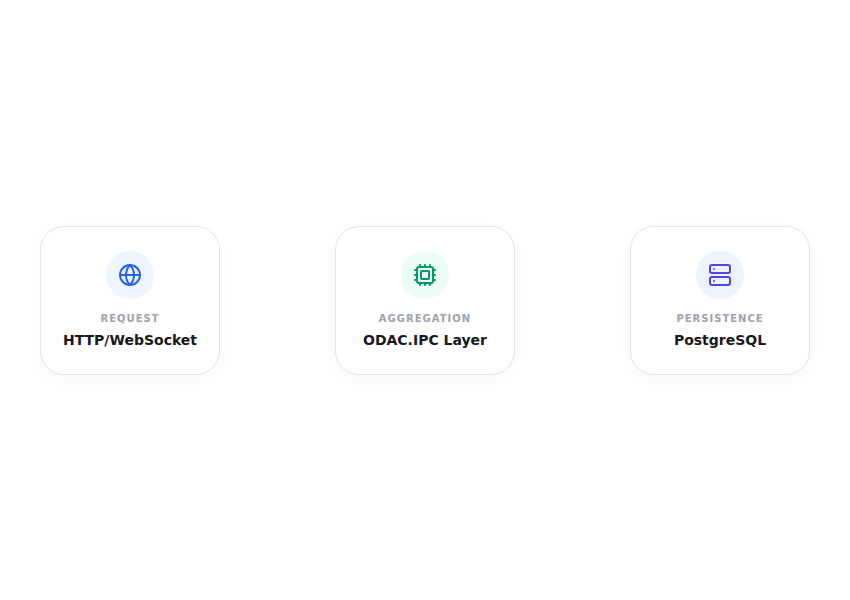
The ODAC.JS Write-Behind Cache is a first-class citizen of the database layer. By simply adding .buffer to your query chain, you delegate the execution to the framework's internal ODAC.IPC (Inter-Process Communication) layer.
Instead of hitting PostgreSQL immediately, the operation is atomically aggregated in-memory across your entire cluster. ODAC.JS then flushes these changes in transaction-safe batches, turning thousands of individual writes into a single, highly optimized database operation.
// High-frequency analytics tracking buffered in memory
// Thousands of calls result in a single batch UPDATE
await Odac.DB.analytics.buffer
  .where({ page_id: 104 })
  .increment('page_views', 1);

// Aggregating user activity without blocking the request
await Odac.DB.users.buffer
  .where(userId)
  .update({ last_active: new Date(), last_ip: req.ip });

// Batching audit logs for delayed bulk insertion
await Odac.DB.audit_logs.buffer.insert({
  user_id: 42,
  action: 'login',
  timestamp: Date.now()
});
Architecture: Zero-Config, Multi-Driver
The magic happens in the ODAC.IPC layer. By default, ODAC.JS uses a memory-backed driver that synchronizes state between cluster workers via the primary process. The aggregation itself is lock-free and requires zero external dependencies to get started.
For horizontally scaled environments, you can switch the IPC driver to Redis in your odac.json. The API remains identical, but the state is now shared across multiple physical servers with a distributed lock ensuring that exactly one server flushes at a time.
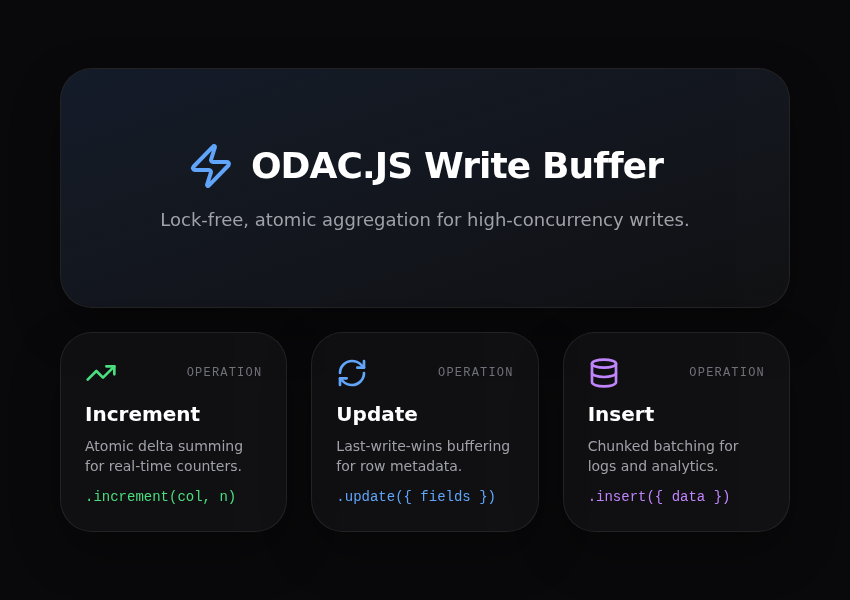
| Operation | Strategy | Benefit |
|---|---|---|
| Increment | Atomic Delta Summing | Merges thousands of +1 calls into one +N update. |
| Update | Last-Write-Wins | Only the final state of a row is written during the flush. |
| Insert | Chunked Batching | Queues rows and executes bulk inserts in 1,000-row chunks. |
Durability and Graceful Degradation
We know what you are thinking: "What happens if the process crashes?"
ODAC.JS is built for the enterprise, which means we don't ignore the edge cases. While the buffer is in-memory, we implement a 30-second checkpoint system using LMDB for the local memory driver. If your primary process dies, it recovers the pending writes from the checkpoint on the next startup.
Furthermore, the framework's graceful shutdown handler is wired directly into the buffer. When a SIGTERM is received, ODAC.JS automatically executes a final, atomic drain of the IPC queue to ensure every pending transaction hits the database before the process exits.
When to Reach for the Buffer
The Write-Behind Cache is designed for non-safety-critical, high-frequency data. It is perfect for view counters, session tracking, and activity logs where sub-second database consistency isn't worth the architectural overhead.
However, we are very clear about the boundaries. You should never use the buffer for financial transactions, order processing, or any operation where a 5-second delay in visibility would break your business logic. For those, the standard ODAC.DB transaction-safe queries remain the gold standard.
ODAC.JS continues to push the boundaries of what a "zero-config" framework can do. With the Write-Behind Cache, we have eliminated one of the most common scaling bottlenecks in Node.js applications, allowing you to focus on building features instead of managing connection pools.