ODAC.JS Foreign Key Sync Engine

Most Node.js developers treat database migrations like a fragile paper trail of sequential append-only files. You write a script to add a column, another to add an index, and eventually, a third to painstakingly define a foreign key constraint. If you ever need to change that constraint, you are back to writing manual ALTER TABLE statements and hoping your production environment matches your local state.
We decided that this manual labor is beneath the modern enterprise developer. ODAC.JS was built on the philosophy of "declarative truth," and today we are pushing that philosophy to the database layer. The ODAC.JS migration engine has been upgraded to support full, zero-config foreign key introspection and synchronization.
The End of Manual Alterations
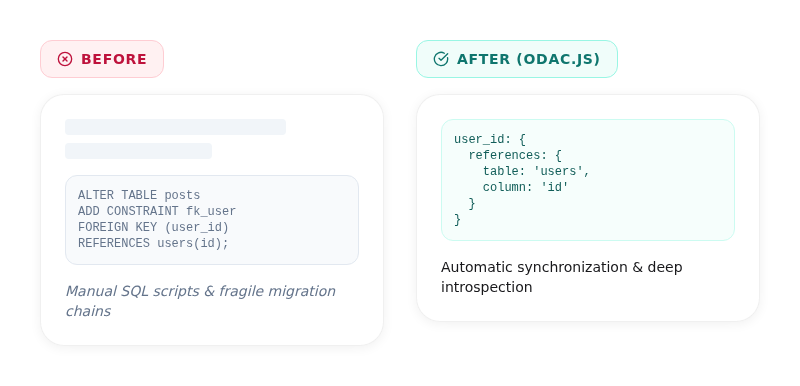
Referential integrity is the backbone of a healthy database, yet it is often the most neglected part of migration workflows because it is hard to manage. Different drivers handle constraints differently, and modifying an existing foreign key usually requires a messy "drop and recreate" dance.
ODAC.JS now handles this dance for you. Instead of writing a script that describes how to change the database, you simply describe what the database should look like. The sync engine introspects your existing schema, compares it to your code-based definition, and generates the precise SQL needed to bridge the gap.
Show Me The Code
Defining a relationship in ODAC.JS is now as simple as adding a few properties to your column definition. There are no separate migration files to track and no raw SQL strings to verify.
// schema/posts.js
'use strict';

module.exports = {
  columns: {
    id: { type: 'increments' },
    title: { type: 'string', length: 255 },
    content: { type: 'text' },
    user_id: {
      type: 'integer',
      unsigned: true,
      references: { table: 'users', column: 'id' },
      onDelete: 'CASCADE',
      onUpdate: 'CASCADE'
    },
    timestamps: { type: 'timestamps' }
  }
};
When you start your application with odac dev or run npx odac migrate, the engine performs a deep scan of your database. If the user_id column exists but lacks the constraint, ODAC.JS adds it. If you change onDelete: 'CASCADE' to onDelete: 'SET NULL', the engine detects the mismatch, drops the old constraint, and applies the new one automatically.
Intelligent Introspection
The magic happens in the introspection layer. Unlike traditional ORMs that only look at their own internal migration history, ODAC.JS looks at the actual database. This means the framework is aware of the current state of your indexes, column types, and now, foreign keys.
This "Source of Truth" approach eliminates the drift that occurs when developers make manual changes to the database or when branches with conflicting migrations are merged. If it is in your schema/ file, it will be in your database.
Cross-Driver Normalization
One of the biggest hurdles in Node.js development is maintaining consistency across different environments. You might use SQLite for local testing but PostgreSQL in production. Historically, foreign key behavior across these engines was inconsistent at best.
ODAC.JS normalizes this experience. The sync engine handles the heavy lifting of cross-driver default value normalization and constraint management.
For SQLite users, we have implemented a robust table-recreation strategy. Since SQLite has limited support for ALTER TABLE operations on constraints, ODAC.JS intelligently handles the data migration and table swapping required to update your foreign keys without data loss.
Precise Synchronization
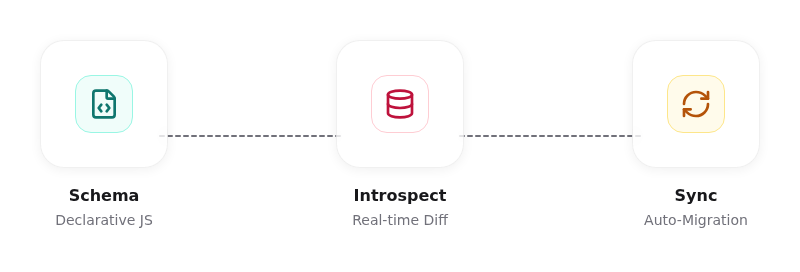
The migration engine does not just blindly execute commands. It calculates the most efficient path to reach the target state.
- Introspect: The engine queries the database system catalogs to understand existing constraints.
- Compare: It matches these against your
schema/*.jsdefinitions. - Sync: It generates a plan. If a constraint is missing, it is added. If it is different, it is updated. If it is no longer defined, it is dropped.
This level of precision ensures that your database remains lean and perfectly aligned with your application logic, allowing you to focus on building features instead of managing schema shifts.
Getting Started
To leverage the new synchronization engine, simply update your schema files in the schema/ directory. The next time your application boots or you run the CLI, ODAC.JS will handle the rest.
# Sync your schema changes immediately
npx odac migrate
With ODAC.JS, your database schema is no longer a historical record of changes: it is a living, breathing reflection of your code.