Why ODAC.JS Bypassed Knex for ClickHouse

Relational databases are magnificent for transactions, but they grind to a screeching halt when you force them to query billions of telemetry events, clickstreams, or unstructured logs. Developers often patch this by spinning up complex external HTTP clients or database drivers. They write unsafe, raw, unescaped SQL strings, and manually manage complex batch buffering logic in an attempt to keep Node.js applications responsive.
In ODAC.JS, we refuse to compromise on developer experience or runtime performance. We did not want you to write duct-tape code for analytics. That is why we integrated ClickHouse, the lightning-fast columnar OLAP database, directly into the core of ODAC.DATABASE.
But our biggest architectural decision was not just adding ClickHouse. It was deliberately choosing to bypass Knex, our trusted companion for relational databases, to build a dedicated, compiler-driven analytics engine from the ground up.
The Architectural Choice: Bypassing Knex
Knex is a phenomenal query builder for row-oriented databases like PostgreSQL and MySQL. However, row-oriented transactional databases (OLTP) and column-oriented analytical databases (OLAP) are entirely different species.
ClickHouse does not work like PostgreSQL. It thrives on massive, append-only bulk insertions and relies on specialized table engines like MergeTree. It implements custom Time To Live (TTL) storage policies and outright rejects row-level mutations or read-through caching.
Trying to force ClickHouse through a traditional SQL query builder would have introduced unnecessary bloat, diluted syntax-level validation, and tempted developers into critical anti-patterns.
Instead, we designed a dedicated ClickHouseAdapter and a custom AST-compiling query builder named ClickHouseQuery. This allowed us to build a stream-friendly, append-only workflow optimized specifically for columnar query performance.
Zero-Config Setup
Adding real-time enterprise analytics to your ODAC.JS application is a matter of configuration. Open your odac.json file and define your connection under a custom key, such as analytics:
{
  "database": {
    "default": {
      "type": "postgresql",
      "host": "localhost",
      "database": "main_prod"
    },
    "analytics": {
      "type": "clickhouse",
      "host": "localhost",
      "port": 8123,
      "user": "default",
      "password": "",
      "database": "analytics"
    }
  }
}
Once the connection is configured, ODAC.JS recognizes your analytical store and unlocks the entire telemetry toolkit.
Schema-First Analytical Migrations
In ODAC.JS, schemas remain the single source of truth. We extended our migration engine to natively support ClickHouse-specific table structures inside the schema/analytics/ directory.
You can declare a schema and specify ClickHouse attributes like engine, orderBy, partitionBy, ttl, and settings directly in JavaScript:
// schema/analytics/clicks.js
module.exports = {
  engine: 'MergeTree',
  orderBy: ['created_at', 'user_id'],
  ttl: 'created_at + INTERVAL 30 DAY',

  columns: {
    id: { type: 'nanoid' },
    user_id: { type: 'bigInteger' },
    event: { type: 'string' },
    path: { type: 'string' },
    created_at: { type: 'datetime', nullable: false }
  }
};
Run migrations using the standard command-line utility:
npx odac migrate --db=analytics
The Strict Non-Null Guardrail
Traditional SQL engines treat database columns as nullable unless you explicitly declare them as NOT NULL. ClickHouse flips this default, treating columns as non-nullable unless explicitly specified.
To prevent runtime errors and ensure predictable behavior across databases, ODAC.JS enforces ClickHouse's native semantics. A column in an analytical schema is only treated as nullable if you explicitly pass nullable: true to its column configuration. Everything else compiles down to strict, non-nullable ClickHouse types.
High-Performance Writes via the Write-Behind Buffer
In high-throughput telemetry, writing individual rows on every incoming request is a severe performance bottleneck that degrades databases. ClickHouse requires writes to be batched to maximize disk merge efficiency.
ODAC.JS includes an intelligent write-behind buffer powered by WriteBuffer. When your API receives telemetry data, you insert it directly into the in-memory or IPC-synchronized queue:
Odac.DB.analytics.clicks.buffer.insert({
  user_id: userId,
  event: 'pageview',
  path: pagePath,
  created_at: new Date()
});
The underlying database adapter automatically coalesces these micro-inserts and flushes them to ClickHouse in large, high-performance batches behind the scenes.
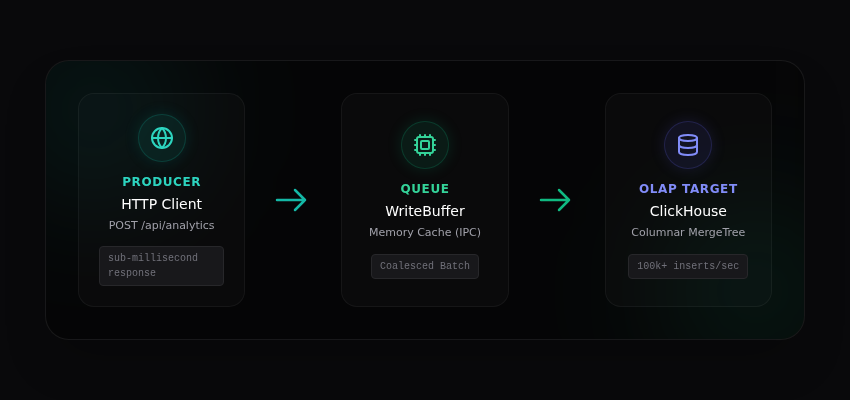
This architecture decouples the HTTP response cycle from the physical database write, ensuring sub-millisecond response times for your API clients.
Querying Millions of Rows Securely
Reading ClickHouse data is just as elegant. ODAC.JS exposes a fluent, chainable, and SQL-injection-proof query builder on top of the Odac.DB.analytics proxy.
Here is how you track events and retrieve top statistics inside an ODAC.JS controller:
// src/controller/AnalyticsController.js
class AnalyticsController {
  async track(request) {
    const userId = await request.data('userId');
    const pagePath = await request.data('path');

    // High-performance batch insert via ODAC.DATABASE WriteBuffer
    Odac.DB.analytics.clicks.buffer.insert({
      user_id: userId,
      event: 'pageview',
      path: pagePath,
      created_at: new Date()
    });

    return { success: true };
  }

  async getTopPages() {
    // Fluent select query compiled safe against SQL injection
    const topPages = await Odac.DB.analytics.clicks
      .select('path', 'count() AS total_views')
      .groupBy('path')
      .orderBy('total_views', 'desc')
      .limit(10);

    return topPages;
  }
}
The query builder translates your method calls into optimized ClickHouse SQL, automatically handling connection pooling, escaping parameters, and parsing tabular responses.
Edge Cases and Analytical Gotchas
Transitioning from relational databases to analytical column stores requires a shift in engineering mindset. Keep these two critical points in mind:
- Explicit Nullability: ClickHouse columns are non-nullable by default. Always verify your schema configurations and mark columns with
nullable: trueif they must accept null values. - Read-Only Mutations: ClickHouse does not support cheap row-level updates or deletes. Traditional query builder commands like
.update()or.delete()are intentionally blocked. For updating metrics or counters, write new event records with negative deltas or utilize specialized aggregating engines likeSummingMergeTree.
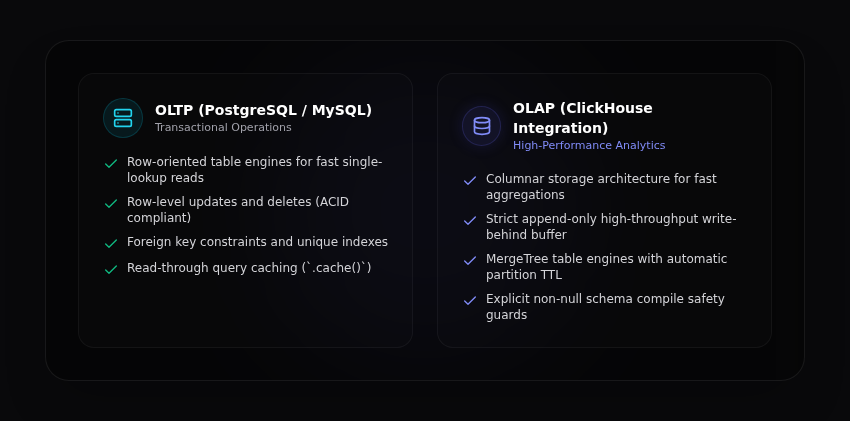
By building a specialized, lightweight query pipeline that respects ClickHouse's strengths, ODAC.JS enables you to manage real-time analytics with unparalleled ease.