Zero-Config Shared WebSockets in ODAC.JS
Let's talk about the silent killer of Node.js real-time applications: the multi-tab browser user. You build an elegant WebSocket architecture, only to watch your server buckle because a single user opened your application in ten different tabs. Suddenly, you are managing ten redundant, idle connections for a single active session.
The traditional approach is to accept this massive network overhead or implement a complex architectural band-aid. You might be forced to introduce Redis, Pub/Sub channels, and complex frontend state management just to deduplicate connections. We found this completely unacceptable. At ODAC.JS, our philosophy is Zero Dependency, Maximum Power. We demanded a solution that provides single-connection multiplexing across browser tabs without touching external infrastructure.
The result is the native ODAC.JS Shared WebSocket architecture. By seamlessly abstracting the browser's SharedWorker API, ODAC.JS provides zero-config cross-tab connection pooling out of the box. If a user opens five tabs, your server only handles one connection.
Show Me The Code: The Frontend Client
The simplest way to use WebSockets in the frontend is our built-in client. It handles automatic reconnection and CSRF token injection natively.
// A single connection shared across all tabs
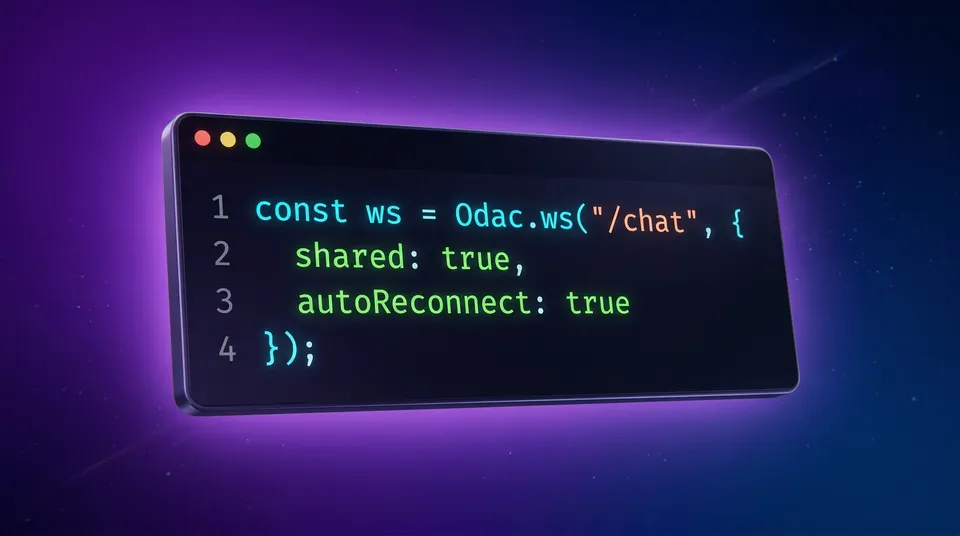
const chat = Odac.ws('/chat', {
  shared: true,
  autoReconnect: true
})

chat.on('message', data => {
  console.log('Received in this tab:', data)
})

chat.send({ type: 'message', text: 'Hello from Odac.ws' })
Notice the shared: true flag in the configuration object. That is the entire setup required. Behind the scenes, ODAC.JS spins up a background worker to hold the actual WebSocket connection. All tabs communicate with this worker, which proxies messages to your server.
If a browser lacks support for this feature, ODAC.JS gracefully falls back to a standard per-tab connection. You get enterprise-grade connection multiplexing with absolutely zero architectural overhead.
The Backend Routing Architecture
The backend developer experience must be just as elegant. ODAC.JS routes WebSockets using the exact same paradigm as standard HTTP routes. Everything is accessed through the global Odac object. There are no redundant handler signatures or convoluted middleware chains to learn.
// route/websocket.js
Odac.Route.ws('/chat', Odac => {
  Odac.ws.send({ type: 'welcome', message: 'Connected!' })

  Odac.ws.on('message', data => {
    console.log('Received:', data)
    Odac.ws.broadcast({ type: 'broadcast', data })
  })

  Odac.ws.on('close', () => {
    console.log('Client disconnected')
  })
})
By default, ODAC.JS actively secures your WebSocket routes. The initial handshake automatically requires a valid CSRF token. We refuse to leave security as an afterthought.
Rooms and Stateful Broadcasting
Real-world enterprise applications require targeted broadcasting. ODAC.JS provides a native Room API for this exact purpose. You do not need to install an external adapter or a heavy third-party library to group your users.
Odac.Route.ws('/room/{roomId}', async Odac => {
  const { roomId } = Odac.Request.data.url
  const user = await Odac.Auth.user()

  if (!user) {
    Odac.ws.close(4001, 'Unauthorized')
    return
  }

  Odac.ws.join(roomId)

  Odac.ws.on('message', data => {
    Odac.ws.to(roomId).send({
      type: 'message',
      user: user.name,
      text: data.text
    })
  })
})
This pattern scales effortlessly. You inject dynamic URL parameters directly into the connection path. You validate the user using the built-in authentication module. Finally, you place the connection into a room and broadcast strictly to that explicit scope.
Lifecycle-Aware Timers
Memory leaks are the bane of long-lived real-time applications. If you attach a standard native interval to a connection handler, it will silently bleed memory after the connection drops unless you meticulously clear it. ODAC.JS solves this with lifecycle-aware timers.
Odac.Route.ws('/live-updates', Odac => {
  // This interval automatically stops when the socket closes
  Odac.setInterval(() => {
    Odac.ws.send({ type: 'tick', timestamp: Date.now() })
  }, 1000)
})
Using Odac.setInterval guarantees that the interval is automatically garbage-collected the exact moment the socket closes. You write less boilerplate, manage less state, and ship significantly more stable code.
ODAC.JS Shared WebSockets eliminate the fundamental scaling bottlenecks of real-time web applications. We replaced architectural complexity with a simple boolean flag. Your server handles a fraction of the connections, your frontend state remains synchronized across tabs, and your development cycle accelerates.