Stop Writing Fragile Rate Limiters in ODAC.JS
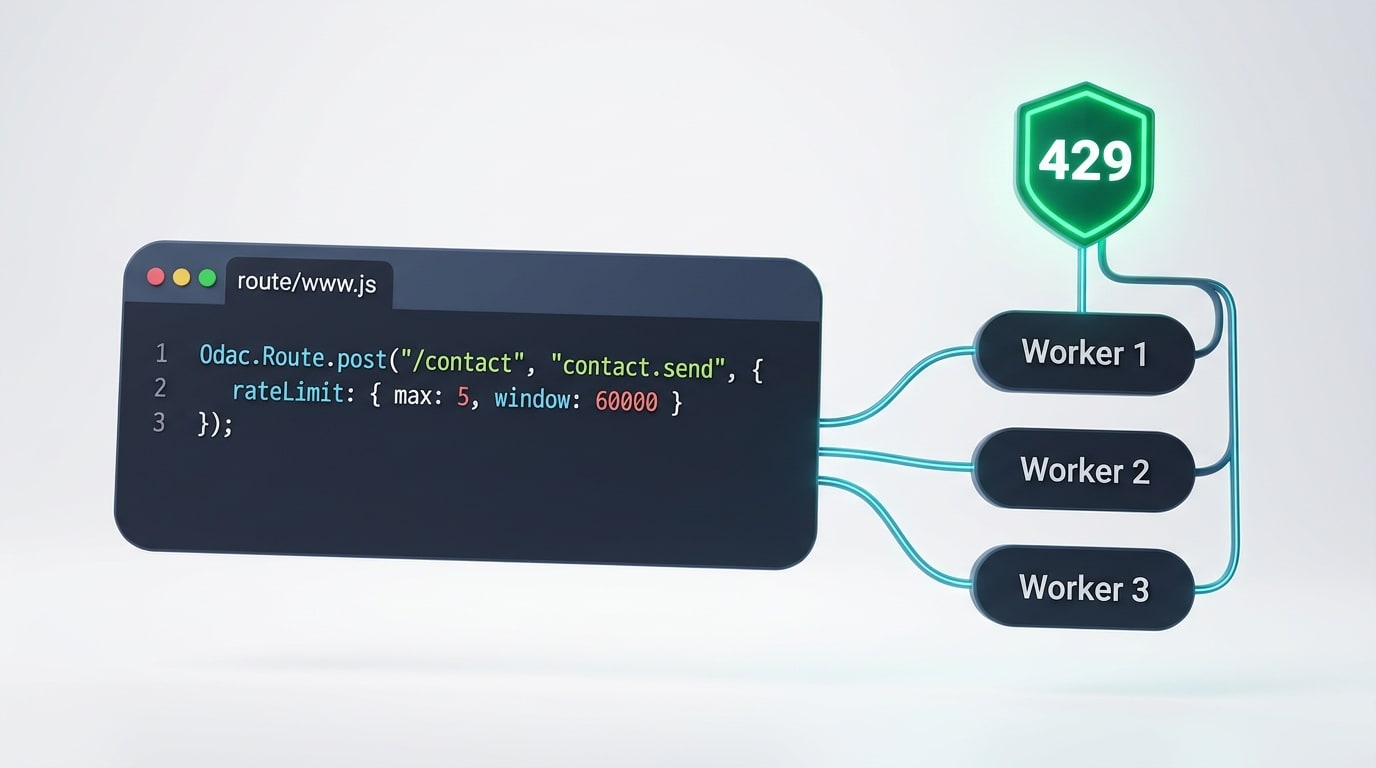
If your Node.js rate limiter lives inside a new Map(), you do not have a rate limiter. You have a polite suggestion that silently multiplies by the number of CPU cores on your server.
In local development, an in-memory Map looks heroic. One process, one counter, clean 429 responses in your terminal. Then you deploy to production with 8 cluster workers, and a bot hammering POST /contact with a "strict" limit of 5 requests per minute slips 40 requests past your defenses. Scale horizontally to three containers behind a load balancer, and that limit balloons to 120 requests while your workers burn CPU initializing sessions and checking CSRF tokens for traffic that should have been rejected at the door.
Previously, ODAC.JS already protected WebSocket streams with per-connection message throttling on Odac.Route.ws() and guarded passwordless sign-in flows with multi-layer cooldowns in Odac.Auth.magic(). Standard HTTP endpoints and form targets, however, had no framework-level gate. ODAC.JS v1.6.0 closes that gap with built-in, cluster-wide HTTP rate limiting wired directly into the routing pipeline and backed by Odac.Ipc.
Show Me The Code
You can enforce a rate limit directly on a route definition or share a single budget across multiple endpoints using middleware. No third-party packages, no manual setInterval cleanup, and no per-worker drift.
// route/www.js: Per-route IP limit and per-account authenticated limit
Odac.Route.post('/contact', 'contact.send', {
  rateLimit: { max: 5, window: 60000 }
});

Odac.Route.auth.post('/api/export', 'api.export', {
  rateLimit: {
    max: 10,
    window: 3600000,
    key: Odac => Odac.Auth.user()?.id
  }
});
When multiple endpoints draw from the same quota, create a reusable middleware with Odac.Route.rateLimit() and chain it onto your routes:
// middleware/apiLimit.js: Shared budget across routes
module.exports = Odac.Route.rateLimit({ max: 100, window: 60000, name: 'api' });

// route/api.js
Odac.Route
  .use('apiLimit')
  .post('/api/upload', 'api.upload')
  .post('/api/import', 'api.import');
Both styles use the same underlying counter store in Odac.Ipc. Whether your application runs across local Node.js cluster workers or multiple containers talking to Redis, the math stays exact.
Why Pipeline Placement Matters
Most Express or custom middleware limiters fail on efficiency before they even fail on clustering. When a rate limiter sits inside generic controller logic or late in a middleware stack, an attacker flooding your endpoint still forces the server to load user sessions, parse payloads, and validate CSRF tokens on every doomed request.
In ODAC.JS, the rate limit gate sits at an exact, intentional point in the request lifecycle:
- Route Match: The router resolves the target route and verb.
- Authentication Gate: For
Odac.Route.authroutes,Odac.Auth.check()runs first. - Rate Limit Check: ODAC.JS evaluates the
rateLimitrule and increments the shared counter. - Session, CSRF, and Controller: Only requests within budget initialize session state, verify CSRF tokens, and enter your controller.
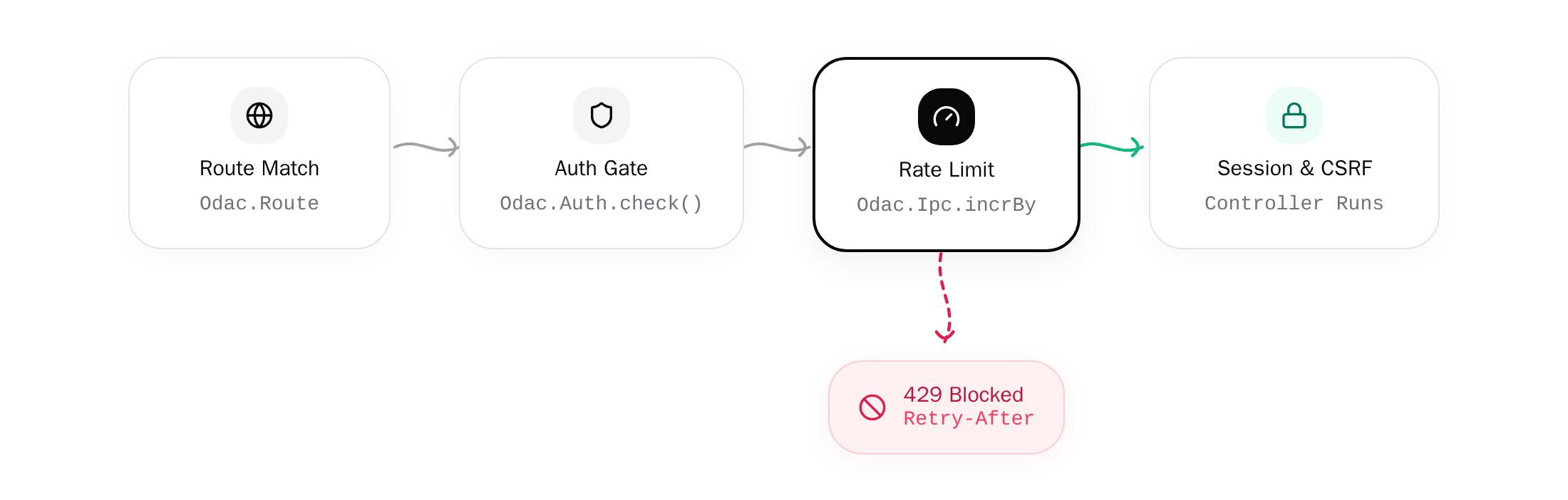
Putting the limiter right after Odac.Auth.check() solves two problems at once. First, unauthenticated traffic hitting an Odac.Route.auth endpoint is bounced before it can touch or pollute rate-limit buckets. Second, authenticated requests already have user context ready, so a key callback like Odac => Odac.Auth.user()?.id works cleanly without loading the rest of the request pipeline.
At the same time, running before session initialization, CSRF validation, and controller execution means excess traffic is dropped with 429 Too Many Requests at minimal CPU cost.
Per-Route Budgets vs. Shared Middleware
ODAC.JS separates single-route limits from grouped limits so you never accidentally share a counter you meant to isolate, or isolate a counter you meant to share.
- Per-Route Option (
{ rateLimit }): PassrateLimitin the options object ofOdac.Route.get(),Odac.Route.post(), or any HTTP verb (includingOdac.Route.auth.get()andOdac.Route.auth.post()). Each route path and HTTP verb gets its own independent budget. - Shared Middleware (
Odac.Route.rateLimit()): Wrap a group of routes with.use('apiLimit')or passOdac.Route.rateLimit(...)directly to.use(). Every route attached to that middleware shares one combined counter per client key.
Every declaration accepts three options:
max(required): Maximum number of requests allowed per window. Must be a positive integer.window(default60000): Window duration in milliseconds. Must be a positive integer.key(default: client IP): A function(Odac) => stringthat identifies the caller. Returningnull,undefined, or''exempts the request from counting entirely.
One subtle trap when sharing budgets across files or routes: always specify a stable name option in Odac.Route.rateLimit({ max, window, name }). Giving the limiter an explicit name anchors its counter bucket in Odac.Ipc. Without a stable name, reordering route files or changing middleware registration order could rename the underlying bucket on your next deploy and wipe active counters mid-window.
Returning an empty value from key(Odac) is also your escape hatch for trusted traffic. Need to exempt internal health probes or admin accounts from a strict public throttle? Return null when the request qualifies, and ODAC.JS skips the counter altogether.
// Exempt admin users while limiting standard accounts to 20 requests per minute
Odac.Route.auth.post('/api/search', 'Search@query', {
  rateLimit: {
    max: 20,
    window: 60000,
    key: Odac => {
      const user = Odac.Auth.user();
      if (user?.role === 'admin') return null;
      return user?.id;
    }
  }
});
Cluster-Wide by Default, Redis-Ready at Scale
Zero-config only works if the default path is already production-safe on a single machine, and the multi-host path requires zero code changes.
Because ODAC.JS stores rate-limit counters through Odac.Ipc, the default memory driver coordinates counts atomically via Odac.Ipc.incrBy across every worker in your Node.js cluster. You do not need to install or run Redis just to get accurate rate limiting on a single server.
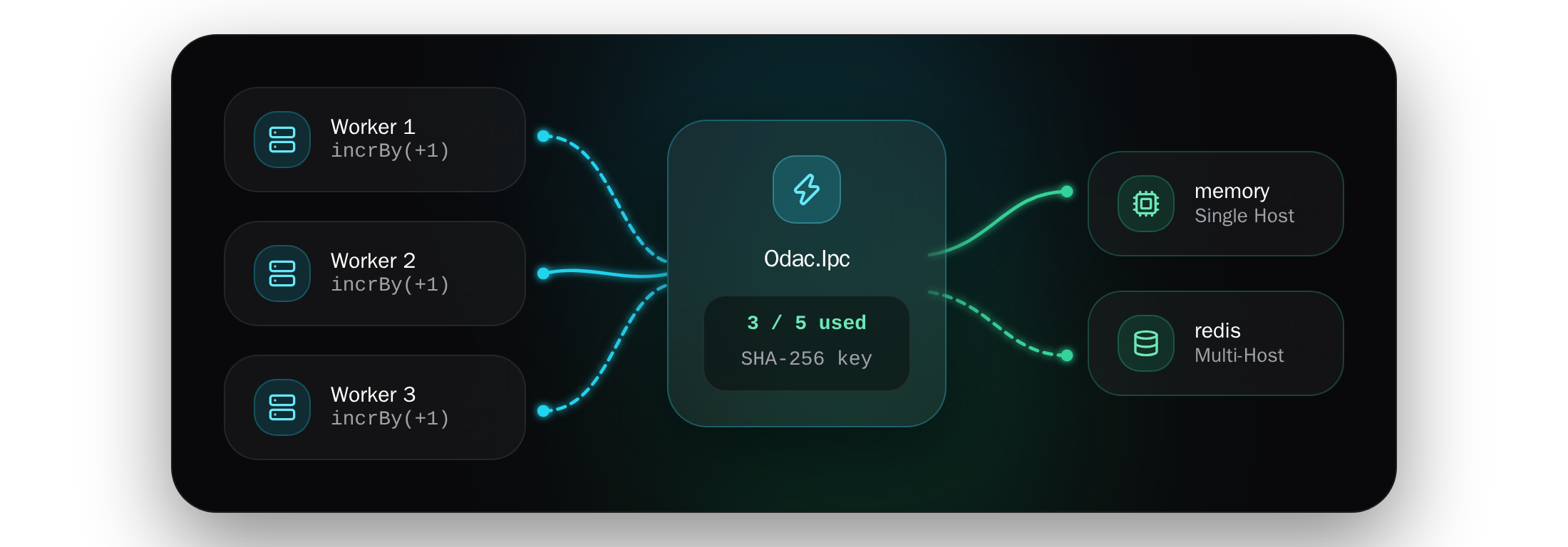
When your application outgrows one host and spans multiple containers, switch your IPC driver in odac.json to redis:
{
  "database": {
    "redis": {
      "default": {
        "url": "${REDIS_URL}"
      }
    }
  },
  "ipc": {
    "driver": "redis",
    "redis": "default"
  }
}
Your route files stay untouched. Every route limit and shared middleware automatically transitions from cluster-wide memory counters to distributed Redis counters.
We also refused to trust raw client strings as storage keys. Before touching Odac.Ipc, ODAC.JS hashes the bucket scope and resolved client identifier with SHA-256 into a compact base64url digest. Even if a custom key function incorporates arbitrary request metadata or untrusted headers, client-controlled strings cannot bloat IPC memory or collide across scopes.
Standard Headers and Custom 429 Pages
Good rate limiters communicate clearly with clients instead of silently dropping connections. Every counted response in ODAC.JS automatically emits three response headers:
RateLimit-Limit: The configuredmaxrequest budget for the window.RateLimit-Remaining: How many requests remain in the current window.RateLimit-Reset: Seconds remaining until the current window resets.
When a client exceeds max, ODAC.JS stops the pipeline before your controller runs, includes a Retry-After header, and responds with 429 Too Many Requests.
If you want branded HTML or structured JSON instead of the default 429 response, register an error handler with Odac.Route.error(429, ...) just as you would for 404 or 500 pages:
// route/www.js
Odac.Route.error(429, 'errors/rate-limit');
// controller/errors/rate-limit.js
module.exports = function (Odac) {
  Odac.response.status(429);

  if (Odac.Request.header('accept')?.includes('application/json')) {
    return {
      error: 'Too many requests. Please try again shortly.'
    };
  }

  return Odac.view('errors/429', {
    title: 'Too Many Requests',
    message: 'You have sent too many requests in a short period. Please wait a moment and try again.'
  });
};
That gives API consumers clean JSON error payloads and browser visitors a styled page using the exact same controller pattern you already use across ODAC.JS.
The Engineering Trade-Offs We Made
Every rate-limiting algorithm chooses between accuracy, memory footprint, and failure behavior. Rather than hiding those choices behind vague marketing claims, here is exactly how ODAC.JS v1.6.0 behaves under edge conditions:
- Fixed, clock-aligned windows: Counters align to fixed window boundaries (
Math.floor(now / window)). Fixed windows require a single atomicOdac.Ipc.incrByincrement instead of storing per-request timestamps or sorted sets, keeping latency sub-millisecond and memory minimal. The known trade-off is boundary bursting: a client can send up to2 × maxrequests in a short burst that straddles the edge of two adjacent windows. If an endpoint triggers expensive downstream work, sizemaxwith that2 × maxburst envelope in mind. - Fail-fast at boot: Invalid declarations such as
max: 0, negative numbers, or a non-numericwindowthrow immediately when the route file loads. Misconfigured limits fail loudly in development or startup rather than silently passing traffic in production. - Fail-open at runtime: If
Odac.Ipcbecomes temporarily unreachable during a Redis blip, or if a customkey(Odac)callback throws an unexpected error, ODAC.JS logs the error and allows the request to proceed. Rate limiting exists to protect availability, never to turn a transient IPC hiccup into a full application outage.
Lock Down Your Expensive Routes Today
Rate limiting belongs in the router, not scattered across ad-hoc controller checks and broken worker-local Map objects. With ODAC.JS v1.6.0, public form targets, search endpoints, file uploads, and expensive data exports get cluster-accurate protection in three lines of declarative route config, complete with standard RateLimit-* headers and seamless Redis scaling when your fleet grows.