The End of Form Fatigue: ODAC.JS

Stop writing boilerplate.
If you have ever spent a Tuesday afternoon manually syncing frontend validation rules with backend controllers, or wrestling with CSRF token expirations during long-lived sessions, you know the pain.
Forms are the primary bridge between your users and your data, yet they remain one of the most tedious parts of web development. In ODAC.JS, we decided that "tedious" was an architectural bug.
With the release of v1.4.14, ODAC.JS introduces a comprehensive overhaul of its form component system. We have moved away from simple tag parsing toward a sophisticated, metadata-driven architecture that treats forms as first-class citizens.
The Problem with Static Forms
Most frameworks treat forms as either raw HTML strings or loosely coupled components that require manual "wiring" to a backend endpoint. You define your inputs, you write your validation logic in a separate controller, and you cross your fingers that the name attributes match.
When we designed the new ODAC.JS form engine, we focused on three pillars: Declarative Security, Unified Validation, and Zero-Config AJAX.
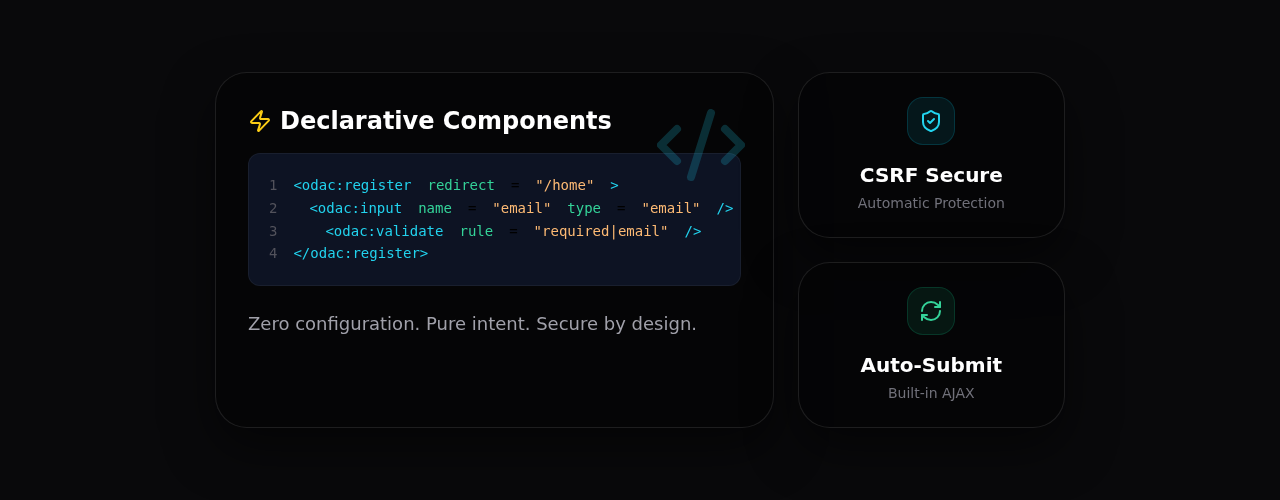
Show Me The Code: The Register Form
The new system allows you to define complex authentication flows entirely within your views using semantic tags. ODAC.JS takes care of the CSRF protection, the AJAX submission, and the server-side validation mapping.
<odac:register redirect="/dashboard" autologin="true">
  <odac:input name="email" type="email" label="Email Address" placeholder="you@example.com">
    <odac:validate rule="required" message="Email is mandatory" />
    <odac:validate rule="email" message="Please enter a valid email" />
  </odac:input>

  <odac:input name="password" type="password" label="Password">
    <odac:validate rule="required" />
    <odac:validate rule="minlen:8" message="Min 8 characters" />
  </odac:input>

  <odac:submit text="Sign Up" loading="Creating account..." />
</odac:register>
Under the hood, ODAC.JS utilizes script:odac runtime hooks. This is a critical architectural advancement because it allows the framework to keep form bodies inline during compilation.
Standard template tags like <odac:if>, <odac:for>, and {{ }} interpolation remain fully functional inside your form blocks. You are not trapped in a specialized DSL; you are using the full power of the ODAC.JS view engine.
Metadata-Driven Architecture
The core of this change resides in src/View/Form.js. The engine now uses a FORM_META structure to define behaviors for register, login, magic-login, and custom form types.
This means that when you use <odac:register>, the framework already knows which database table to target, which encryption salts to apply, and how to handle the post-submission session.
For the ultimate "Developer Experience" (DX) win, look at the magic-login component:
<odac:magic-login redirect="/dashboard" />
That single line generates a secure, email-based passwordless login system. If you do not specify inputs, ODAC.JS provides a default email field and submit button automatically. We believe in sensible defaults that get you to production faster.
Seamless Security: Automatic CSRF Rotation
One of the most frustrating edge cases in modern web apps is the "Expired Session" error when a user leaves a form open for too long, or tries to submit multiple forms in a single session.
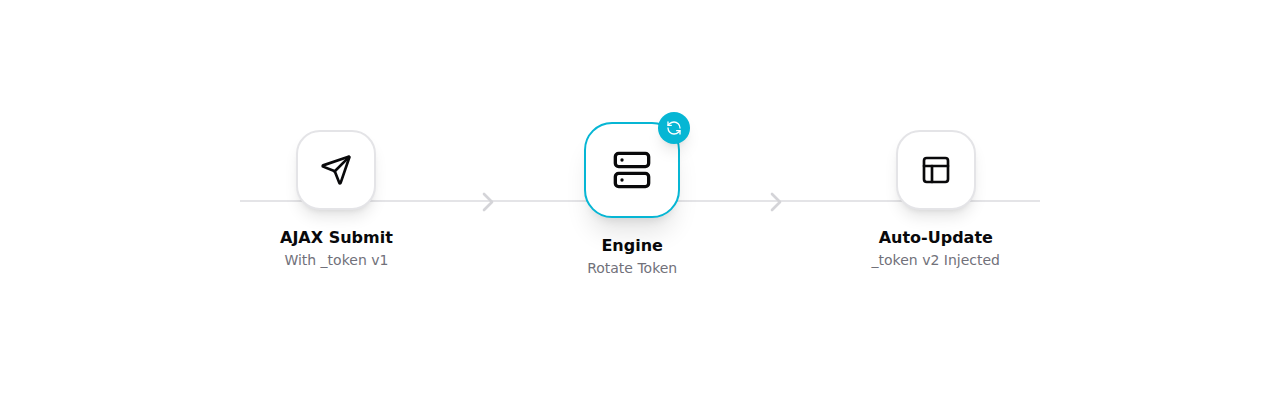
ODAC.JS now handles CSRF security more intelligently. When a successful AJAX form submission occurs, the server provides a fresh token in the response.
The ODAC.JS client-side library (client/odac.js) automatically detects this new token and injects it into all active forms on the page. This "Auto-Rotation" allows for multiple consecutive submissions without a single manual page refresh.
Hardened Against XSS
Security is not just about what we add, but what we prevent. The v1.4.14 update fortifies the view engine against XSS by sanitizing script tags and handling escaped quotes within form configurations.
We have implemented a specialized escapeHtmlPreservingTemplates method that ensures your user-generated content is safe without corrupting the dynamic logic required for template interpolation.
Conclusion
The new form component system in ODAC.JS represents our commitment to "Enterprise-Grade" stability combined with "Zero-Config" speed. By moving to a metadata-driven model, we have eliminated the boilerplate that slows you down, while providing a more secure foundation for your applications.
Ready to build? Open your view/auth/register.html and experience the power of declarative forms today.