ODAC.JS On-Demand Image Optimization
The modern web is an image-heavy battlefield. Yet, for too long, Node.js developers have been forced to choose between two equally frustrating paths: wrestling with complex build-time processing pipelines or paying a premium for external image CDNs. At ODAC.JS, we believe that high-performance image delivery should be a core framework feature, not a third-party afterthought.
Today, we are thrilled to unveil a zero-config, on-demand image optimization engine that lives right where your code does. Whether you are building a high-traffic e-commerce site or a personal blog, ODAC.JS now handles the heavy lifting of resizing, format conversion, and caching without you ever leaving your editor.
The Problem with the Status Quo
Traditional image handling in Node.js often feels like an architectural compromise. You either ship massive, unoptimized JPEGs that tank your Core Web Vitals, or you introduce a processing layer that adds latency and complexity to your deployment. We refused to accept this trade-off.
When we designed the image engine for ODAC.JS, we focused on three pillars: Developer Experience (DX), performance, and reliability. We wanted a solution that was invisible when it worked and bulletproof when it didn't. By integrating directly into the view layer and the controller context, we have eliminated the boilerplate and the bills.
Show Me The Code
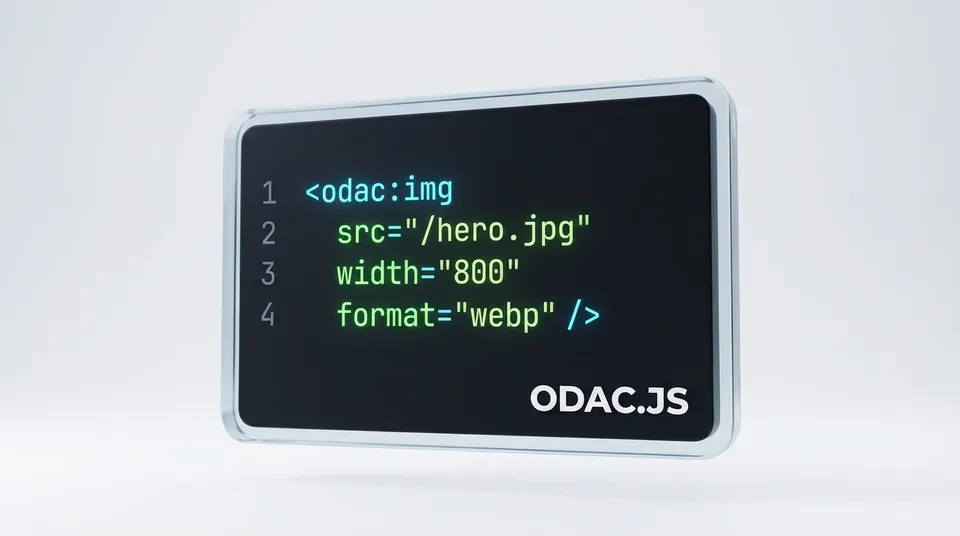
The centerpiece of this update is the new <odac:img> template tag. It looks and feels like a standard HTML image tag, but under the hood, it triggers a sophisticated processing pipeline.
<!-- In an ODAC.JS View Template -->
<odac:img
  src="/hero.jpg"
  width="800"
  format="webp"
  quality="80"
  alt="Hero Image"
  class="rounded-lg shadow-xl"
/>
Upon the first request, ODAC.JS intercepts the path, processes the original image using the industry-standard sharp library, and persists the result to a dedicated cache. Every subsequent visitor receives the optimized asset instantly.
Programmatic Power
Sometimes you need more than just a tag. Perhaps you are generating a JSON API for a mobile app or setting a dynamic background image in a CSS block. For these scenarios, we have exposed the Odac.image() programmatic API.
// Inside an ODAC.JS Controller
const avatarUrl = await Odac.image('/avatar.png', {
  width: 150,
  height: 150,
  format: 'webp'
});

// Pass the URL to your view or return it in a JSON response
Odac.set({ avatarUrl });
This API shares the same O(1) FIFO cache and processing logic as the template tag, ensuring consistency across your entire application.
Intelligent Caching and Busting
One of the biggest headaches in asset management is cache invalidation. How do you ensure users see the new version of an image without changing the filename? ODAC.JS solves this by using the source file's modification time (mtime) as a seed for the cache hash.
The resulting filenames are human-readable and SEO-friendly, looking something like hero-800-a1b2c3d4.webp. When you replace the original file in your public/ directory, the framework automatically detects the change, generates a new hash, and busts the cache for you. No manual versioning required.
Built-in Resilience
We understand that not every environment needs heavy-duty image processing. The sharp dependency is strictly optional. If it is missing from your node_modules, ODAC.JS will not crash. Instead, it gracefully logs a console warning and falls back to serving the original, unprocessed image.
Furthermore, to prevent resource exhaustion attacks, we have implemented a strict whitelist for output formats and a hard cap on dimensions. Your server stays stable, your memory usage stays low, and your users stay happy.
Getting Started
Ready to slash your page load times? The setup is as simple as it gets.
- Install the optional dependency:
npm install sharp. - Start using the
<odac:img>tag in your views. - Watch your Lighthouse scores climb.
ODAC.JS is more than just a framework: it is an ecosystem designed to help you build enterprise-grade applications with minimal friction. With native image optimization, we are taking one more step toward making the "Fast Path" the only path.